Do you ever wish you clone your best scientist?
Lots of organizations do. There’s something about a really skilled thinker, someone with the ability to take an intangible idea and make it a real, testable thing, that feels just a bit like magic. But it’s that same magic which also happens to be a major weakness in laboratories and research circles around the world.
After all, what happens when our best scientist retires, or moves on to another opportunity and takes that knowledge with them? What about when new hires need to be trained, and that same scientist’s valuable time must now be spent to show these new colleagues how to replicate an experiment that seemingly only the seasoned scientist can reproduce?
How about the lack of clarity inherent in the current way methods are written?
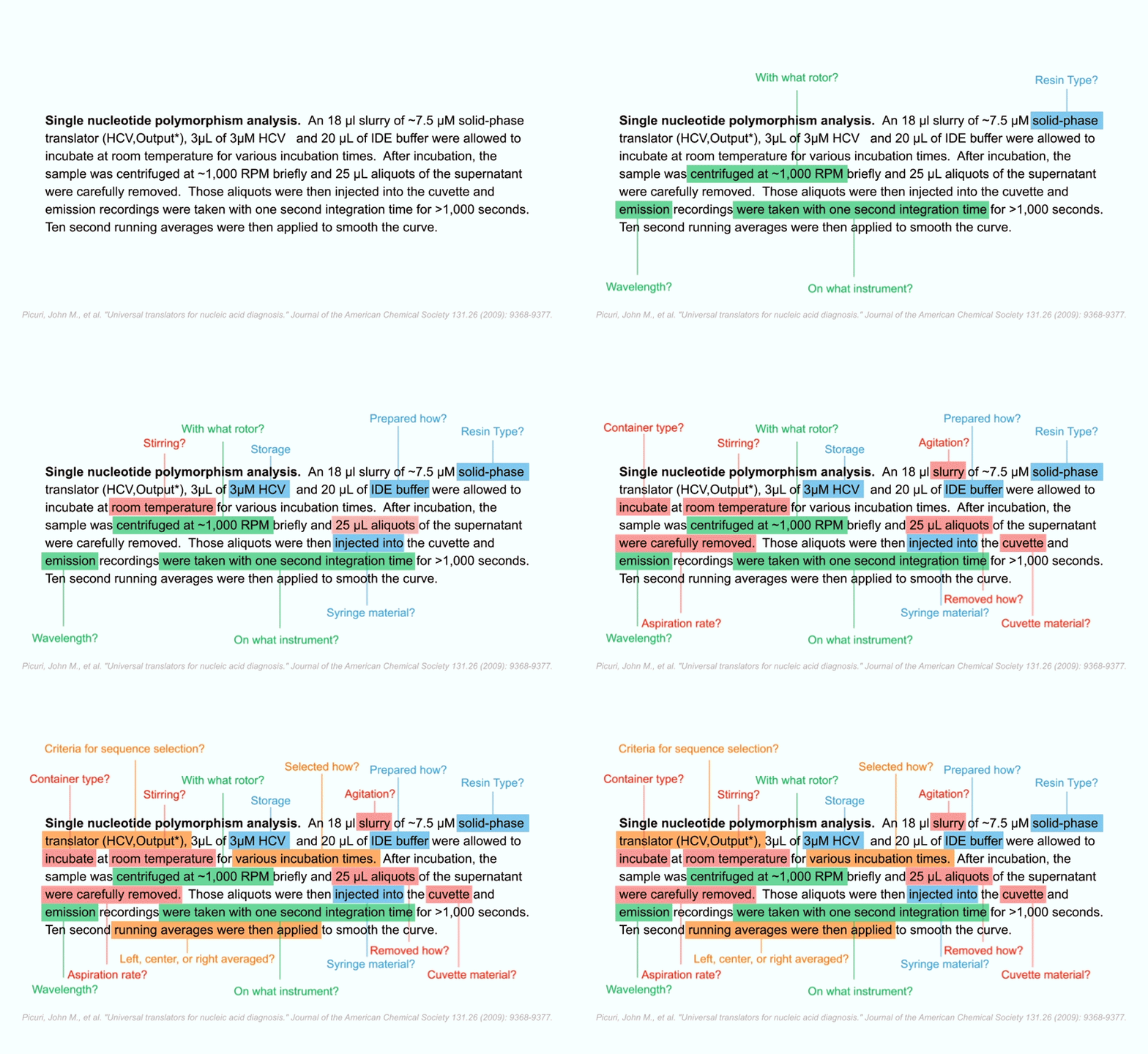
It seems the life science industry, particularly when it comes to research and development, has made its peace with accepting that these challenges always were and always will be.
Not necessarily.
Enter the era of cloud laboratories, where the traditional notion of protocols takes a quantum leap into the digital realm, becoming nothing less than snippets of code that unlock a new era of scalability, adaptability, and collaboration. Today, we’ll explore the landscape of code-driven experimentation and uncover its potential to reshape the future of scientific collaboration.
The Evolution of Protocols: From Pages to Pixels
Traditionally, scientific protocols have been meticulously documented on paper or in digital formats as step-by-step guides for experimental procedures. While these documents serve their purpose, they often lack the dynamic adaptability required in the fast-paced and collaborative environment of modern research. The ability to write code for experiments is a revolutionary approach that transforms these protocols into living, breathing entities encoded in the language of machines or in the case of Emerald Cloud Lab, symbolic lab language (SLL).
In a cloud laboratory setting, protocols are no longer static instructions but dynamic lines of code. This transformation offers myriad advantages, especially for organizations looking to maximize efficiency, reduce costs, and foster collaboration.
A Scientific Symphony: Genome Assembly to Therapeutics Proteins

Imagine a scenario where one research group pioneers a novel genome assembly method and publishes it as a code-based protocol. This digital blueprint becomes instantly accessible to other researchers worldwide. Now, another group, aiming to advance directed evolution techniques, taps into this genome assembly code as the foundational step in their process. They seamlessly integrate it, creating a unique hybrid protocol for their work.
The collaborative symphony continues when a third group, building upon the directed evolution technique, codes a process that automatically optimizes proteins for therapeutic robustness in gastric conditions. This protocol, in turn, becomes an asset for biotech companies and researchers seeking to develop protein therapeutics with enhanced bioavailability.
In this scenario, the traditional handover of methods is transformed into a digital handoff, with each group building upon the work of the previous one. The result is a cascade of innovations, each made possible by the seamless integration of protocols existing as code.
Benefits of Code-Driven Protocols
1. Efficiency and Speed:
Traditional protocols can be time-consuming to interpret and execute. With code-driven protocols, the process is streamlined, reducing the time from experimental design to results. Organizations can iterate faster, accelerating the pace of innovation.
2. Cost Reduction:
The digital nature of code-driven protocols eliminates the need for physical documentation, storage, and manual transcription. This not only reduces costs but also minimizes the risk of errors associated with manual data entry.
3. Scalability:
As organizations grow, so do their protocols. Code-driven protocols provide a scalable framework, allowing for easy modification and expansion as research needs evolve. This adaptability is crucial for companies navigating the uncertainties of scientific exploration.
4. Global Collaboration:
Code-driven protocols transcend geographical boundaries. Researchers from different corners of the world can seamlessly collaborate by building upon existing code, fostering a truly global and interconnected scientific community.
The Emerald Advantage
Now that we’ve glimpsed the potential of code-driven protocols, imagine harnessing this power within the world’s first cloud laboratory – Emerald Cloud Lab. Our platform not only embraces code-driven protocols but amplifies their impact by providing a centralized hub for their creation, storage, and execution.
Emerald Cloud Lab is designed with science-driven organizations in mind, offering a user-friendly interface that empowers researchers to control experiments remotely. And while this software is robust enough to deal with the complexities of the intended studies, you do not need to write the code in order to capture methods. Consider the example screenshot below taken from Command Center. As parameters are specified (left-hand side) corresponding code is generated in the Command Builder. In this way, a consistent experience is created when working across all instrumentation in the lab.

The future of scientific collaboration is here. It may not yet be possible to clone your best scientist, but there are other and more effective ways to accelerate your discovery, research, and development. For more information, or to book a demo of the Emerald Cloud Lab, please follow this link.